


As the oldest design festival of its kind in the country, DesignPhiladelphia highlights the work of thousands of local designers, architects and creative professionals to demonstrate Philadelphia’s reemergence as a 21st century city shaped by thoughtful design, collaborative business practices and community engagement.
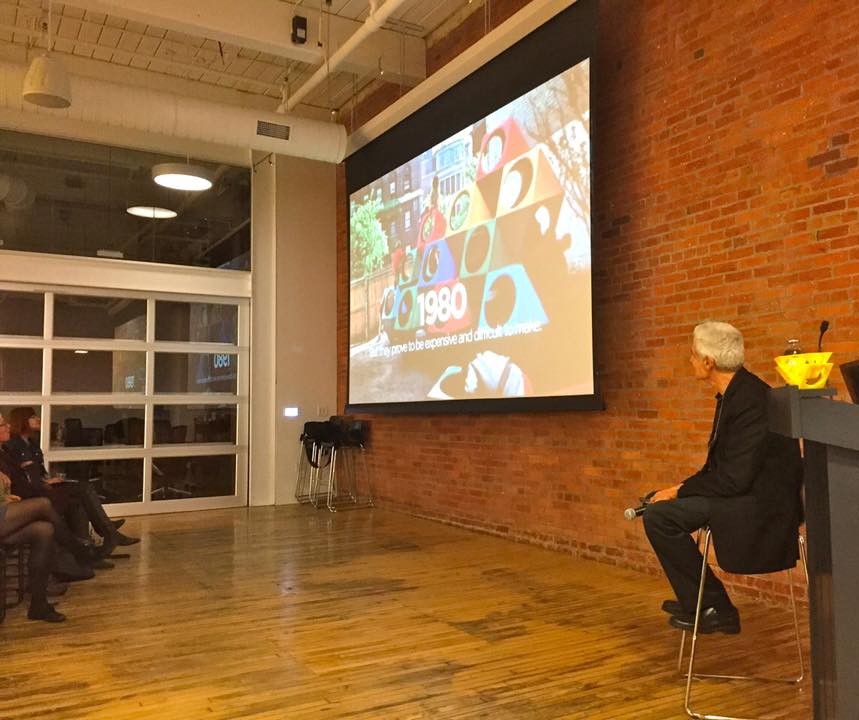 On October 13 as part of DesignPhiladelphia, Architect Richard Dattner, FAIA, presented “Modular Design – Lessons Learned” at the Center for Architecture & Design. Dattner discussed the highs (the fun of designing), lows (patent infringement, material costs, money) and happy outcome (the relaunch of PlayCubes) of this career-long adventure.
“The revival of PlayCubes through my collaboration with Playworld is a terrific moment,” said Dattner. “These timeless structures, reimagined for today’s world, provide children with the opportunity to use their senses for learning how their body works, feeling textures, colors and their environment–free from parental micromanagement.”
At the beginning of our DesignPhilly event, I was happy to introduce Richard Dattner, members of our design team from Playworld and representatives from GEA, George Ely and Associates. Sean Plank of GEA donated his time and efforts to provide a beautiful PlayCubes exhibit. This exhibit once again attracted hundreds of locals to play in, around and on top of a sculptural, geometric shape. Just as exhibit staff from recent PlayCubes exhibits in Boston, MA and Portland, OR, the Philly AIA staff was also extremely appreciative of the PlayCubes exhibit during DesignPhilly 2016! This is just another example of how we are witnessing communities enjoying this beautiful geometric design. Our evening in Philly ended with questions from the audience about material choices, manufacturing practices and the limitless design options of a cuboctahedron, an appealing geometric shape combining cubes and pyramids.
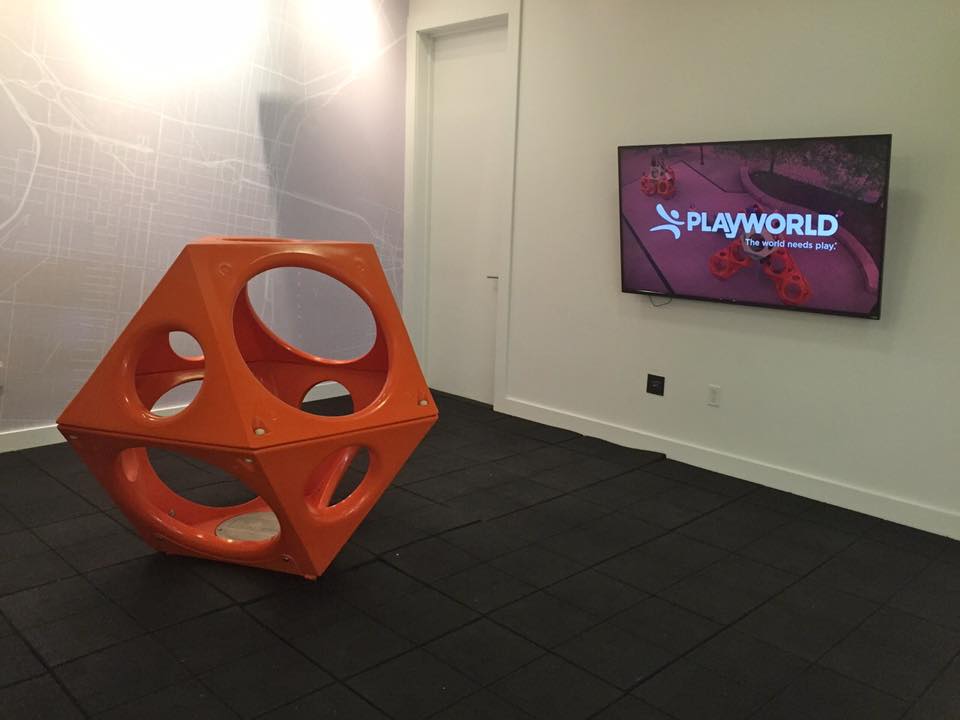 Dattner incorporated the interlocking structures into his designs for playground equipment and patented the original PlayCubes in 1968. Today’s PlayCubes allow designers to use one or more forms to create their own unique and beautiful play spaces. Play sculptures such as PlayCubes allow the worlds of design and play to mesh, providing a unique and innovative play space for children as well as a focal point for any community.
For me, the most appealing aspect of play sculpture is witnessing the amount of play happening in unusual environments such as seen here during DesignPhilly, the Boston AIA space and at the current exhibition at the PNCA in Portland, OR. I believe we are seeing a great movement to provide play everywhere and PlayCubes are proving to be a solution for pop up play. They will be activating spaces and bringing us all together for many years to come!
What aspects of play sculpture appeal to you the most?
